Pular para o conteúdo principal

IMF Says Only 23% of Central Banks Can Legally Issue Digital Currencies – Regulation Bitcoin News

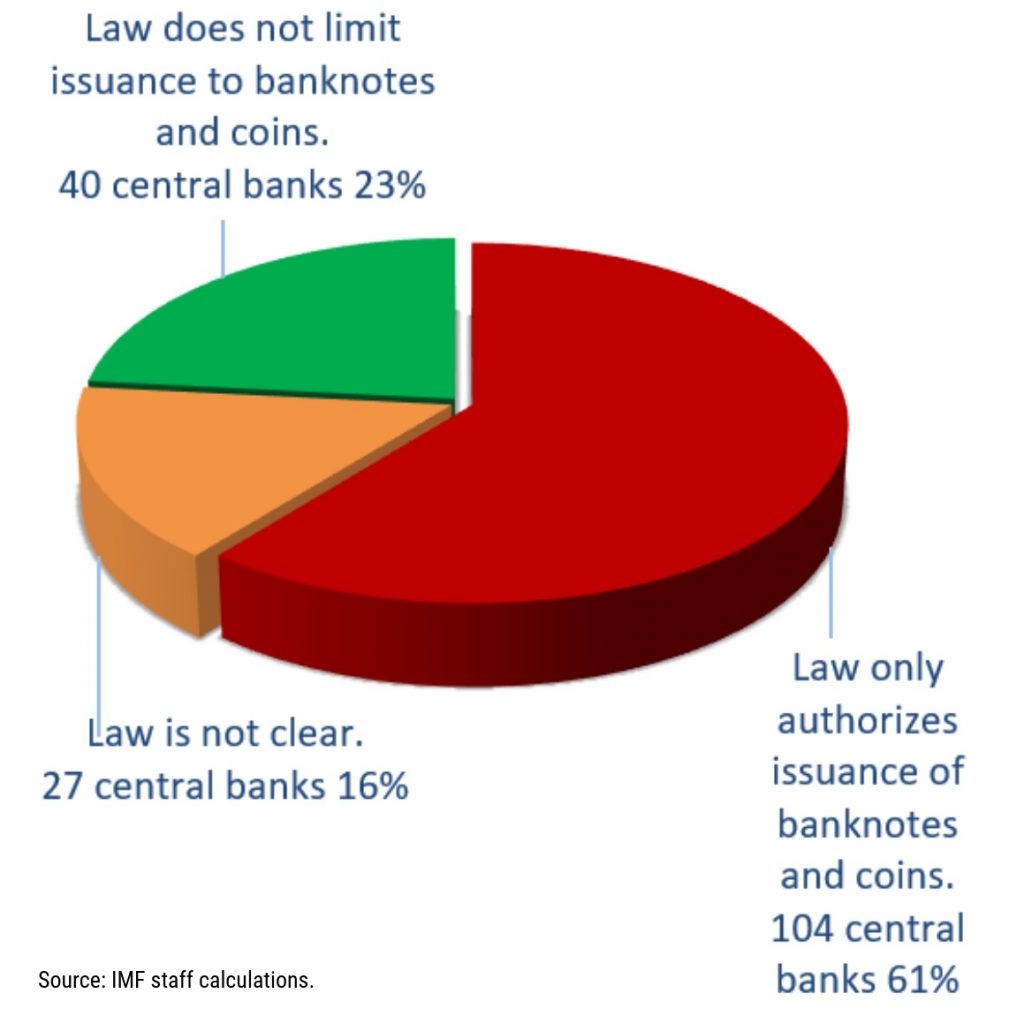
Researchers at the International Monetary Fund (IMF) have examined the central bank laws of 174 IMF members to answer the question of whether a digital currency is really money. They found that of all the central banks studied, only about 23%, or 40 central banks, “are legally allowed to issue digital currencies.”

The IMF published a blog post on Thursday exploring whether digital money is really money in the legal sense. The post is authored by Catalina Margulis, a consulting counsel in the IMF Legal Department’s Financial and Fiscal Law unit, and Arthur Rossi, a research officer in the same unit.

Expressing their own views, the authors began by observing that “close to 80 percent of the world’s central banks are either not allowed to issue a digital currency under their existing laws, or the legal framework is not clear.” They continued:

To help countries make this assessment, we reviewed the central bank laws of 174 IMF members … and found out that only about 40 are legally allowed to issue digital currencies.
IMF Says Only 23% of Central Banks Can Legally Issue Digital Currencies

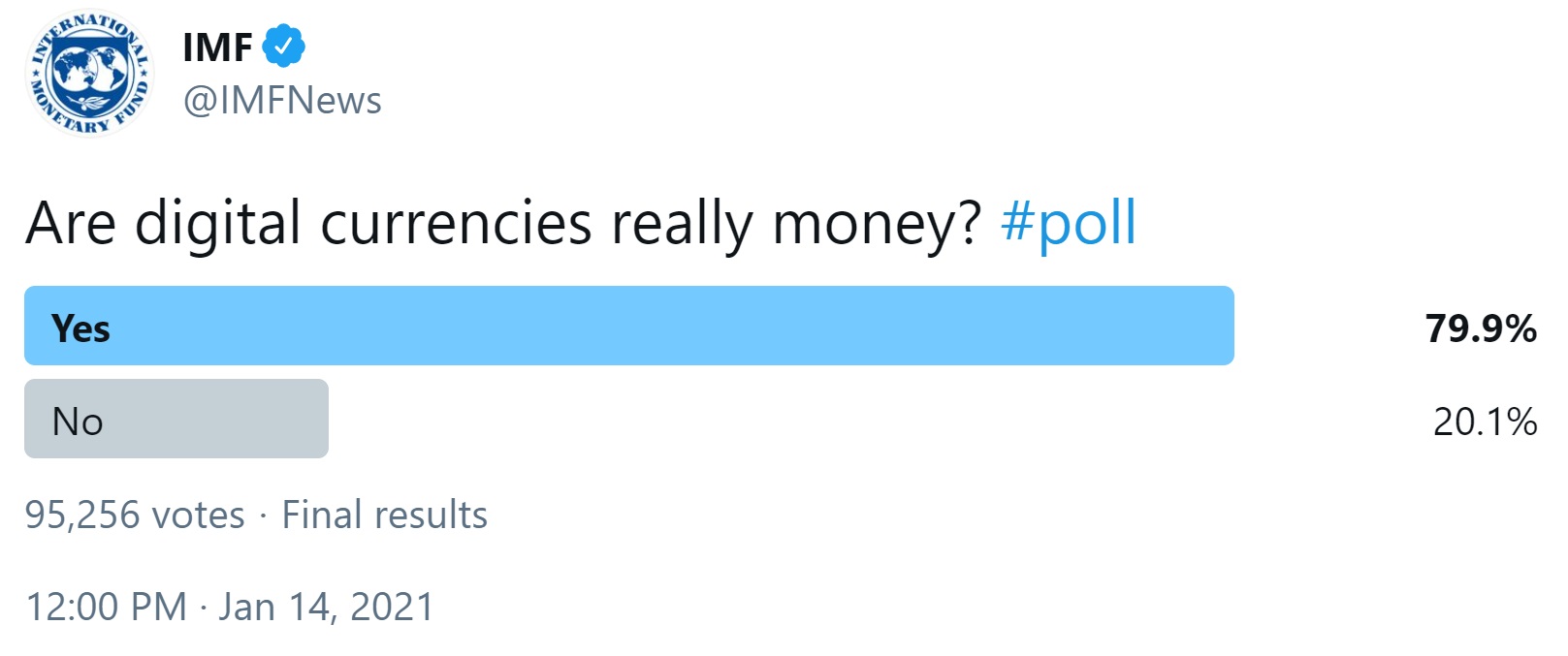
Prior to the publication of this blog post, the IMF set up a poll on Twitter asking people to vote on whether they think digital currencies are really money. Out of 95,256 votes collected, 79.9% said yes.
IMF Says Only 23% of Central Banks Can Legally Issue Digital Currencies

The IMF researchers noted that “To legally qualify as currency, a means of payment must be considered as such by the country’s laws and be denominated in its official monetary unit. A currency typically enjoys legal tender status, meaning debtors can pay their obligations by transferring it to creditors.” They detailed:

Therefore, legal tender status is usually only given to means of payment that can be easily received and used by the majority of the population. That is why banknotes and coins are the most common form of currency.

The authors noted that to “use digital currencies, digital infrastructure — laptops, smartphones, connectivity — must first be in place.” However, they pointed out that “governments cannot impose on their citizens to have it, so granting legal tender status to a central bank digital instrument might be challenging.”

The IMF staff also mentioned some legal issues raised by the creation of central bank digital currencies (CBDCs). Among the areas of concern are “tax, property, contracts, and insolvency laws; payments systems; privacy and data protection; most fundamentally, preventing money laundering and terrorism financing,” the IMF researchers described.

In conclusion, while noting that “Without the legal tender designation, achieving full currency status could be equally challenging,” the researchers emphasized:

Many means of payments widely used in advanced economies are neither legal tender nor currency.

Do you think digital currencies are money? Let us know in the comments section below.

Image Credits: Shutterstock, Pixabay, Wiki Commons, IMF, Twitter

Spot-markets for Bitcoin, Bitcoin Cash, Ripple, Litecoin and more. Start your trading here.

Disclaimer: This article is for informational purposes only. It is not a direct offer or solicitation of an offer to buy or sell, or a recommendation or endorsement of any products, services, or companies. Bitcoin.com does not provide investment, tax, legal, or accounting advice. Neither the company nor the author is responsible, directly or indirectly, for any damage or loss caused or alleged to be caused by or in connection with the use of or reliance on any content, goods or services mentioned in this article.

Comentários

Postagens mais visitadas deste blog

St Marche: a história da improvável rede de supermercados que fatura R$ 800 milhões

A história de Bernardo Ouro Preto e Victor Leal, que também trouxeram o Eataly para o Brasil, é tema do episódio do podcast Do Zero ao Topo SÃO PAULO – Sem qualquer experiência no varejo, dois executivos resolveram criar uma rede de supermercados voltada para a classe A em 2002. A ideia foi desencorajada por todos os banqueiros e executivos com MBAs de universidades Ivy League que a dupla conhecia. Mas Bernardo Ouro Preto e Victor Leal resolveram seguir em frente. Contrariando probabilidades, o St Marché é hoje uma rede com 20 lojas e que faturou cerca de R$ 800 milhões em 2020. “As ideias inovadoras que a gente teve na época foram rebatidas pelas pessoas que conhecem o business. Aí a gente tomou a decisão de que iríamos inovar e, para fazer isso, contratamos só gente que não vinha desse business”, contou Bernardo Ouro Preto, fundador e CEO da companhia em entrevista ao podcast Do Zero ao Topo . As 10 melhores corretoras para investir em ações, segundo a Proteste Curso gratuito: como v...

IPCA-15 sobe 0,78% em janeiro, maior resultado para um mês de janeiro desde 2016, mas levemente abaixo do esperado

A expectativa do mercado, segundo estimativa média da Refinitiv, era de alta de 0,81% na comparação com dezembro O Índice Nacional de Preços ao Consumidor Amplo 15 (IPCA-15), a prévia da inflação oficial, ficou em 0,78% em janeiro, após registrar 1,06% em dezembro de 2020. Esse é o maior resultado para um mês de janeiro desde 2016, quando o índice foi de 0,92%. Em 12 meses, o IPCA-15 acumula alta de 4,30%, acima dos 4,23% registrados nos 12 meses imediatamente anteriores. Em janeiro de 2020, a taxa foi de 0,71%. Os dados foram divulgados hoje (26) pelo IBGE. A expectativa do mercado, segundo estimativa média da Refinitiv, era de alta de 0,81% na comparação com dezembro e de 4,33% na comparação anual. As 10 melhores corretoras para investir em ações, segundo a Proteste Curso gratuito: como viver de Bolsa operando apenas 1 hora por dia Como investir em ações: passo a passo para quem está começando A energia elétrica, que passou de uma alta de 4,08% em dezembro para 3,14% em janeiro, foi ...

Crypto Exchange Giant Coinbase to Sell Shares Privately Ahead of Public Offering – Bitcoin News

According to a recent report, the San Francisco-based cryptocurrency exchange Coinbase is purportedly planning to sell stock on Nasdaq’s private market ahead of the initial public offering (IPO). Coinbase reportedly notified shareholders that they will receive information pertaining to the private sale this week. Coinbase is the biggest digital currency exchange in the United States and one of the largest trading platforms worldwide. At the time of publication, between BTC and ETH deposits, Coinbase holds over $40 billion in digital assets under management (AUM) according to Bituniverse exchange balance ranks. As far as other digital assets under management the San Francisco exchange recently noted it holds $90 billion AUM in cryptocurrencies. In mid-December, Coinbase announced the confidential filing of an S-1 initial public offering with the U.S. Securities and Exchange Commission. On Friday, the financial columnist from The Block, Frank Chaparro, reported that Coinbase will s...